Q1 2026 Singapore property market update: Private property prices rise while HDB resale prices dip

The Q1 2026 actual property data is out, and the Singapore property market is starting to show a clearer split between the private residential market and the HDB resale market.
Private property prices continued to move up, but at a measured pace. HDB resale prices, on the other hand, recorded their first quarterly decline in nearly seven years.
This does not mean the Singapore property market is crashing. But it does tell us one thing: buyers are becoming more selective, and the gap between HDB resale prices and private property prices is something HDB upgraders need to watch very closely.
Private property market update in Q1 2026
Private residential property prices rose by 0.9% in Q1 2026, higher than the 0.6% increase in Q4 2025. This is also close to the average quarterly increase of 0.8% in 2025, which means private property prices in Singapore are still growing, but not in a runaway manner.
What is interesting is where the growth came from.
Landed homes actually saw prices fall by 0.4% in Q1 2026, after a strong 3.4% increase in the previous quarter. But non-landed private homes, which include condos and apartments, rose by 1.3%, reversing the 0.2% decline in Q4 2025.
In simple terms, Singapore condos are still holding up better than landed properties this quarter.
The strongest price growth came from the Outside Central Region (OCR), where non-landed private property prices rose by 2.2%. The Rest of Central Region (RCR) rose by 0.8%, while the Core Central Region (CCR) rose by 0.6%.
To me, this tells us something important.
Demand is still strongest where the mass-market private property and HDB upgrader demand sits. OCR condos are still being supported by HDB upgraders, family buyers, and homebuyers who want convenience, MRT access, and a more digestible price quantum.
This is why, even though the broader economy may feel uncertain, well-located OCR condos and private residential projects can still move.

But here is the part private property buyers should not ignore: transaction volume softened.
Developers launched 1,844 private residential units excluding ECs in Q1 2026, down from 2,632 units in Q4 2025. Developers sold 2,013 units, down from 2,940 units in the previous quarter.
Private property resale transactions also fell to 3,225 units, from 3,529 units in Q4 2025, while sub-sales dropped to 175 units.
So private property prices went up, but transaction volume came down.
That is the key point.
This is not a Singapore property market where everyone is rushing in blindly. It is more like a selective market where buyers are still willing to pay, but only for the right projects, right locations, and right price points.

Executive Condominiums, or ECs, were also a bright spot in Q1 2026. Developers launched 1,320 EC units and sold 1,168 EC units, compared with zero EC launches and only 80 EC units sold in the previous quarter.
This makes sense. ECs remain a natural bridge for many HDB upgraders in Singapore. They offer condo facilities, a lower entry price than private condos, and the potential to be privatised later. So when the right EC projects come out, demand can still be very strong.
So my read is this: the Singapore private property market is still resilient, but the easy-money market is over.
Buyers need to be more disciplined. You cannot just buy any condo and assume it will perform. Project selection, entry price, floor plan, exit audience, and surrounding future supply will matter even more.
Download our free playbooks:


HDB resale market update in Q1 2026
The HDB resale market showed a very different picture in Q1 2026.
HDB’s Resale Price Index for Q1 2026 was 203.4, a 0.1% decline from Q4 2025. This was the first quarterly decline in HDB resale prices in almost seven years, since Q2 2019.
On the surface, a 0.1% decline looks tiny. And it is.
But symbolically, it matters.
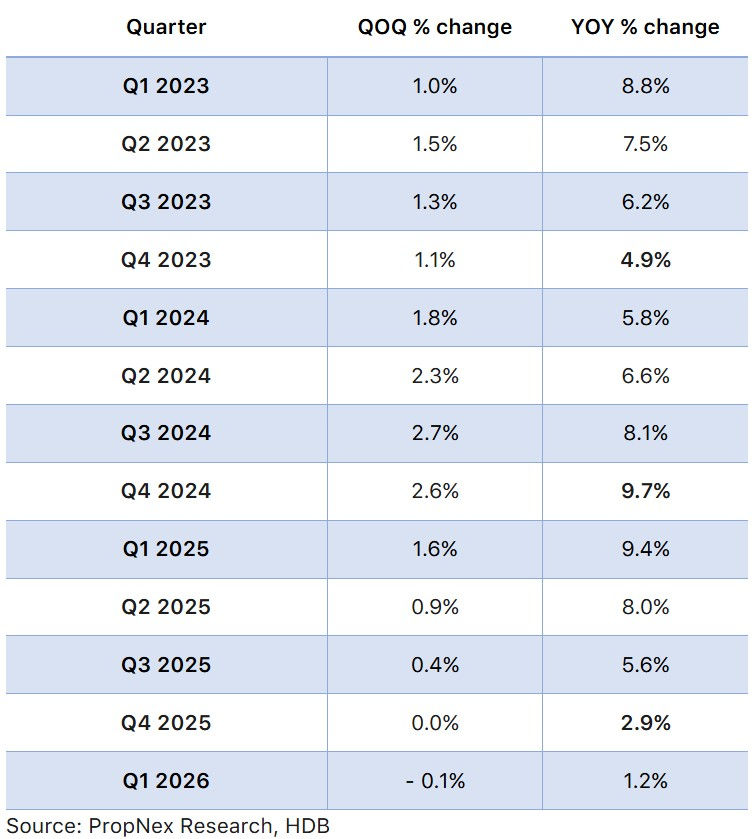
For the past few years, HDB resale prices have been climbing strongly, supported by construction delays, urgent housing demand, pandemic-era supply shortages, and buyers who were priced out or unwilling to wait for BTO flats.
Now, the HDB resale market is starting to normalise.
More BTO supply, more flats reaching MOP, cooling measures, and more buyer options are slowly working through the system. PropNex noted that more than 102,000 BTO flats were launched from 2021 to 2025, helping to satisfy strong public housing demand.
But here is the interesting part: while HDB resale prices dipped slightly, transaction volume went up.
There were 6,285 HDB resale flats sold in Q1 2026, up nearly 20% from 5,256 units in Q4 2025.
That tells us buyers did not disappear. Instead, buyers may return when HDB resale prices become more reasonable.

This is quite important for HDB sellers to understand. The market is not dead. But buyers are no longer chasing every flat at any price.
Pricing strategy matters more now. If sellers price too aggressively, buyers may simply wait, compare, or go for other options.
At the same time, the premium HDB resale segment is still strong.
PropNex reported 412 million-dollar HDB resale transactions in Q1 2026, up from 350 in Q4 2025. A 5-room flat at Dawson Road in Queenstown also reportedly transacted at $1.7 million, setting a new record price for HDB resale flats.
So again, we are not seeing a broad HDB market collapse.
We are seeing market bifurcation.
Normal HDB flats in less scarce locations may face more price resistance. But rare HDB flats in prime locations, near MRT stations, near good schools, with strong layouts, high floors, good views, or limited supply can still command premium prices.
Subscribe to our newsletter if you enjoy insights like this.
My view for HDB upgraders in 2026
For HDB upgraders, if you already have a strong conviction to upgrade from HDB to private property, this is not the time to sit on the fence for too long.
The latest Q1 2026 property data shows HDB resale prices dipping slightly, while private property prices continued to increase. That gap matters.
Because if this gap continues to widen, the move becomes harder.
You may end up selling lower, but buying higher.
That is the real risk for HDB upgraders.
It is not just about whether your HDB flat can still fetch a good price. It is whether your HDB flat can keep pace with the private property you want to buy next.
If private condo prices keep rising while your HDB resale price stays flat or softens, your upgrading gap widens. That means you may need more cash, take on a larger loan, use more CPF, or compromise on the type of private property you can buy.
And in the worst-case scenario, some HDB upgraders may eventually get priced out of the private property they were originally aiming for.
But don’t rush blindly.
Upgrade with a proper property plan. Know your HDB sale price, private property purchase budget, loan eligibility, CPF position, timeline, and exit strategy. The goal is not to upgrade for the sake of upgrading. The goal is to make a move that strengthens your family’s financial position over time.


My view for first-time private property buyers
For first-time private property buyers, the Q1 2026 Singapore property market data is actually quite encouraging.
The private property market is still increasing, but the pace looks stable and measured. This tells us that the market is not moving in a highly speculative manner.
To me, that gives buyers more confidence.
For own-stay buyers, this means you are likely buying into a market where prices are more reflective of real demand, rather than pure hype. You still need to be careful with project selection, layout, entry price, and location. But at least the overall Singapore private property market is not behaving like a runaway market.
For first-time buyers who are looking at property investment, this may also be a window worth studying seriously.
Singapore property remains one of the more stable real estate markets globally because of strong regulation, limited land supply, high home ownership, and consistent long-term demand. Of course, this does not mean every property will make money. Selection still matters a lot.
But in a market where price growth is steady, interest rates are lower than before, and buyer sentiment is more rational, it may be a good time to assess opportunities before the next wave of buyers becomes more aggressive again.
My view is this: don’t wait for the perfect timing.
Most people only wait till the time has passed after prices have already moved.
The better approach is to buy when the numbers make sense, the holding power is there, and the property fits your own-stay or investment objective.
Because in Singapore, it is impossible to time the market.
But buying the right asset, at the right price, with the right holding power — that is something you can control.
Subscribe to our newsletter if you enjoy insights like this.


Comments