UAE leaves OPEC: What it means for oil prices, consumers, data centres and AI

For decades, OPEC has been one of the most important forces in the oil market.
Whenever oil prices collapse, people look at OPEC and ask: “Will they cut supply?”
Whenever oil prices spike, people ask: “Will OPEC increase supply?”
But recently, the oil market became even more interesting.
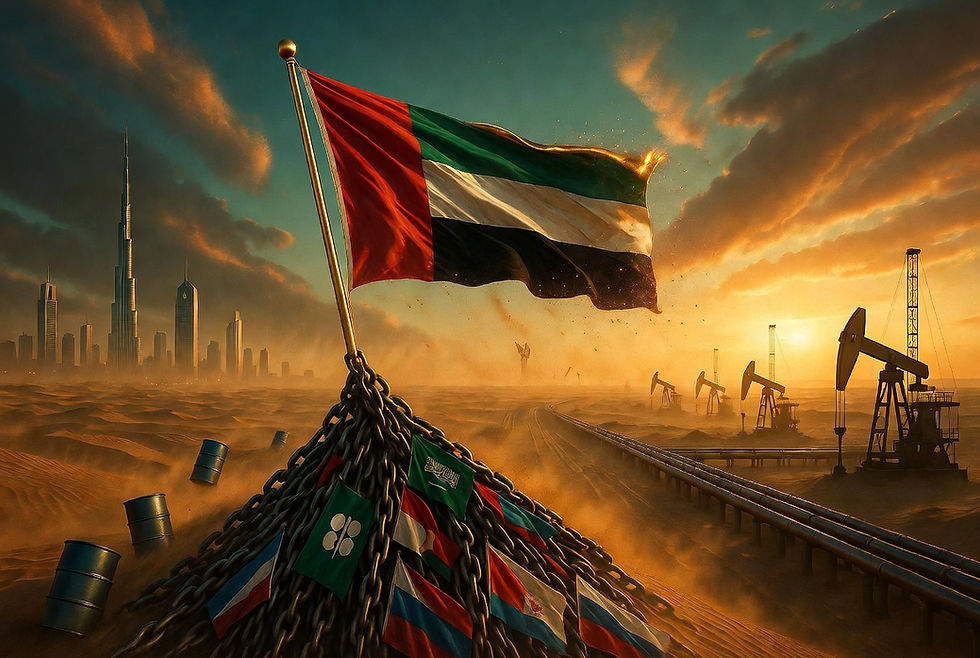
The United Arab Emirates, or UAE, announced that it would leave OPEC and OPEC+ effective 1 May 2026. Reuters described it as a major blow to OPEC and its de facto leader, Saudi Arabia.
At first glance, this may sound like just another geopolitical headline.
But I think the implications are bigger.
This is not just about the UAE. It is about whether the world is moving into a more fragmented oil market — one where producers care less about coordinated supply discipline and more about defending their own national interests.
And if that happens, oil prices may become more market-driven, more competitive, and possibly more volatile.
The interesting question is this:
If weaker OPEC means more supply and lower oil prices, isn’t that actually good for consumers?
Let’s unpack this properly.
First, what is OPEC?
OPEC stands for the Organisation of the Petroleum Exporting Countries.
Think of it as the oil producers’ club.
Its members are oil-producing countries that coordinate oil production policies. In simple terms, when OPEC wants to support oil prices, it may reduce supply. When it wants to calm the market, it may increase supply.
OPEC’s role is not to help consumers get the cheapest oil possible. Its main objective is to protect the interests of oil-producing countries.
That is important to understand.
Because when producers coordinate supply, they can reduce competition. And when competition is reduced, prices may stay higher than they otherwise would be.
Subscribe to our newsletter if you enjoy insights like this.
Then what is OPEC+?
OPEC+ is the wider alliance.
It includes OPEC members plus non-OPEC oil producers. The most important non-OPEC member is Russia.
This matters because OPEC alone no longer controls the oil market the way it used to. The world has changed. US shale production, Russia, Brazil, Canada, Guyana and other producers have become important parts of the global supply.
So OPEC+ was created to give the producers a bigger coordination platform.
When you hear “OPEC+ cuts production” or “OPEC+ increases output”, it usually means this wider group is trying to influence global oil supply.
What about the IEA?
The IEA is different.
IEA stands for the International Energy Agency. It represents the perspective of energy-consuming countries more than oil-producing countries.
So while OPEC is more producer-focused, the IEA is more focused on energy security, demand trends, supply risks, and the energy transition.
That is why OPEC and the IEA often disagree.
OPEC tends to be more bullish on oil demand. The IEA tends to be more cautious, especially when high prices, economic slowdowns, efficiency gains, electric vehicles, and renewables start to affect demand.
For example, the IEA’s April 2026 Oil Market Report projected that global oil demand would decline by an average of 80,000 barrels per day in 2026, after previously expecting growth.
That tells us something important.
Even experts do not always agree on the direction of oil demand. So, as investors, we should not blindly follow anyone's forecast. We need to understand the incentives behind each institution.
Is the UAE too small to matter?
No.
UAE is not Saudi Arabia. But it is not small either.
The UAE has been one of OPEC’s more important producers and has invested heavily in expanding its oil and gas capacity. After leaving OPEC, ADNOC is reportedly set to push ahead with shale-style oil and gas projects, giving the UAE more room to pursue its own production strategy outside OPEC limits.
This is the key point.
The issue is not only how much the UAE produces today.
The bigger issue is that the UAE's departure from OPEC weakens the idea that major producers will continue to sacrifice their own production ambitions for group discipline.
Once one serious producer walks away, the question becomes:
Who else may eventually decide that OPEC quotas no longer serve their national interest?
That is why this matters.

What happens if OPEC becomes weaker?
If OPEC becomes weaker, the oil market becomes more competitive.
In theory, that is good for consumers.
Why?
Because if every producer produces based on its own capacity and national interests, supply could increase. More supply usually means lower oil prices.
Lower oil prices can benefit consumers through cheaper fuel, lower transport costs, lower airline costs, lower shipping costs, and lower inflationary pressure.
So from the consumer’s point of view, weaker OPEC discipline can be a good thing.
But there is a trade-off.
Subscribe to our newsletter if you enjoy insights like this.
The trade-off: lower prices, but maybe more volatility
Oil is already volatile.
Even with OPEC, oil prices move sharply because of wars, sanctions, recessions, shipping disruptions, interest rates, currency movements, inventories, speculative flows, and sudden demand shocks.
So let’s be clear.
OPEC does not stabilise oil prices.
It only tries to manage part of the supply side.
A better way to think about OPEC is this:
OPEC does not remove volatility. It changes the shape of volatility.
With OPEC, producers try to put a floor under prices when supply is too high. But that also means consumers may pay a “producer coordination premium” because supply is artificially managed.
Without strong OPEC discipline, prices may become more market-driven. That can mean cheaper oil during periods of oversupply. But it can also mean sharper boom-bust cycles.
The cycle may look like this:
Producers pump more oil → oil prices fall → investment slows → future supply becomes tight → oil prices spike again.
So yes, a weaker OPEC may be good for consumers in the short to medium term.
But it may also make the market swing more freely.
So, is a weaker OPEC good or bad?
My view: it depends on who you are.
For consumers, a weaker OPEC is probably positive if it leads to more supply and lower prices.
For oil-producing countries, it is negative because they lose pricing power.
For oil companies, it creates uncertainty. If prices fall too much, upstream producers may see lower profits and cut investment.
For central banks, lower oil prices can help reduce inflation pressure.
For investors, it depends on what you own.
If you own oil producers, weaker OPEC discipline may pressure long-term pricing power.
If you own airlines, logistics companies, manufacturing businesses, or consumer-facing companies, lower oil prices may improve margins.
But for AI and data centres, the story is more nuanced.
Want a concise version of Charlie Munger’s 25 human misjudgements? Download here!

How does oil volatility affect data centres and AI?
This is where the discussion becomes interesting.
Data centres do not usually run directly on crude oil.
They run on electricity.
So, oil price volatility does not affect AI infrastructure in the same way it affects airlines or shipping companies.
For AI, the bigger issue is not crude oil.
The bigger issue is power.
Data centres need reliable, massive, 24/7 electricity. The IEA projects that global data centre electricity consumption could roughly double to around 945 TWh by 2030, representing just under 3% of global electricity consumption.
That is huge.
To put it simply, AI is not just a software story anymore.
It is becoming an energy infrastructure story.
Oil affects AI indirectly.
Oil price volatility affects AI through second-order effects.
The first channel is inflation.
When oil prices spike, transport costs rise. Shipping costs rise. Fuel costs rise. Input costs rise. This can push inflation higher.
If inflation stays high, interest rates may stay higher for longer.
That matters because AI data centres are extremely capital-intensive. Companies need to spend billions on GPUs, land, cooling systems, grid connections, networking equipment, and power infrastructure.
Higher interest rates make these projects more expensive to finance.
So, oil may not directly power the data centre, but it can still affect the cost environment around AI infrastructure.
The second channel: backup power
Data centres often use diesel generators as backup power.
They are not meant to run all the time, but they are critical for reliability.
If oil prices spike, diesel becomes more expensive. That raises the cost of backup fuel, testing, storage, resilience planning, and emergency operations.
For the largest hyperscalers, this is manageable.
But for smaller operators, rising backup and energy security costs can matter.
The third channel: electricity markets
This is the most important point.
For data centres, electricity prices matter much more than oil prices.
Natural gas also matters more than crude oil because gas is used for power generation in many markets.
The IEA expects renewables and nuclear to provide nearly 60% of electricity consumed by data centres by 2030, up from around 35% today.
But even if renewables grow, data centres still need reliable 24/7 power. Solar and wind are useful, but they are intermittent. Batteries help, but they do not yet fully solve the problem at scale. Nuclear helps, but it takes time. Natural gas can provide firm power, but it comes with fuel-price and carbon concerns.
That is why data centre companies are increasingly thinking like energy companies.
They are not just asking:
Where can I get land?
They are asking:
Where can I get cheap, reliable, scalable power?

The AI race is becoming a power race.
For years, investors focused on chips.
Who has the best GPUs?Who has the best AI models? Who has the best cloud platform?
These are still important.
But the next bottleneck may be electricity.
If data centre electricity demand doubles by 2030, then power availability becomes a competitive advantage. The IEA also noted that data centre electricity use surged in 2025 even as bottlenecks tightened, driving a scramble for solutions.
That means companies with access to low-cost power, grid capacity, nuclear deals, renewable power agreements, and energy management capabilities may have an advantage.
This benefits hyperscalers like Microsoft, Amazon, Google and Meta because they have the balance sheets to secure long-term power deals.
But it may put pressure on smaller AI companies, since they usually rent compute from cloud providers. If power and infrastructure costs rise, cloud GPU pricing may stay elevated.
In other words:
Big tech can absorb the energy challenge. Smaller AI companies may feel it through higher compute costs.
What does this mean for investors?
For investors, this is the key takeaway:
Do not look at AI as just a software or semiconductor theme.
AI is also a power, grid, cooling, infrastructure and energy-security theme.
Oil volatility may not directly decide the future of AI. But overall energy volatility will shape the economics of AI infrastructure.
The companies that win may not only be the ones with the best models.
They may also be the ones who can secure the cheapest and most reliable power.
That is why the energy layer matters.
Subscribe to our newsletter if you enjoy insights like this.
Bringing it all together
The UAE's departure from OPEC is important because it may signal a weaker era of producer coordination.
If OPEC becomes weaker, consumers may benefit from more competition and more supply.
But oil prices were never truly stable, even with OPEC. The cartel can manage supply, but it cannot control wars, sanctions, demand shocks, shipping disruptions, or the global economy.
So the real takeaway is not that oil will become stable or unstable.
The real takeaway is this:
Oil may become more market-driven.

That can be good for consumers when supply increases. But it can also create sharper boom-bust cycles.
For AI and data centres, oil is not the direct bottleneck. Electricity is.
But oil volatility still matters because it affects inflation, interest rates, logistics, backup power costs, and energy-security thinking.
So if we zoom out, the story is bigger than OPEC.
It is about energy control.
For consumers, cheaper oil is helpful.
For investors, weaker OPEC means less certainty around oil pricing.
For AI, the real question is whether the world can build enough reliable electricity infrastructure to support the next wave of compute demand.
Because in the next phase of AI, the winners may not just be those with the best chips.
They may be the ones with the best access to power.
Final thoughts
OPEC weakening may sound like good news for consumers — and in many ways, it is.
But markets are rarely that simple.
Lower oil prices can help households, businesses and inflation. But if prices fall too much, investment may slow, future supply may tighten, and volatility may return in another form.
For AI, the message is even clearer.
The future of AI will not only be decided in data centres or chip factories.
It will also be decided at power plants, grid connections, substations, cooling systems and energy contracts.
The better question is not whether oil prices will stay volatile.
They probably will.
The better question is:
Who is best positioned to handle energy volatility — and turn it into an advantage?


Comments