HDB upgraders in 2026: Why managing expectations matters more than ever

If you are an HDB owner thinking about upgrading to a condo, this is probably one of the most important mindset shifts to make before you even ask, “How much can I sell my flat for?”
The market has changed.
A lot of HDB upgraders still anchor themselves to older expectations. They remember the strong HDB resale market, hear about a neighbour who sold at a great price, and assume they should hold out for a little more too.
But the problem is this: while many sellers are still hoping for more on the HDB side, the private property they want to upgrade into may already be moving away from them.
That is why expectation management matters so much today.
This is not about telling you to sell cheaply. It is about helping you understand what HDB upgraders are currently facing, and why pricing your home realistically could make the difference between upgrading smoothly and getting priced out.
HDB buyers now have more choices than before
Let us start with the most obvious shift: supply.
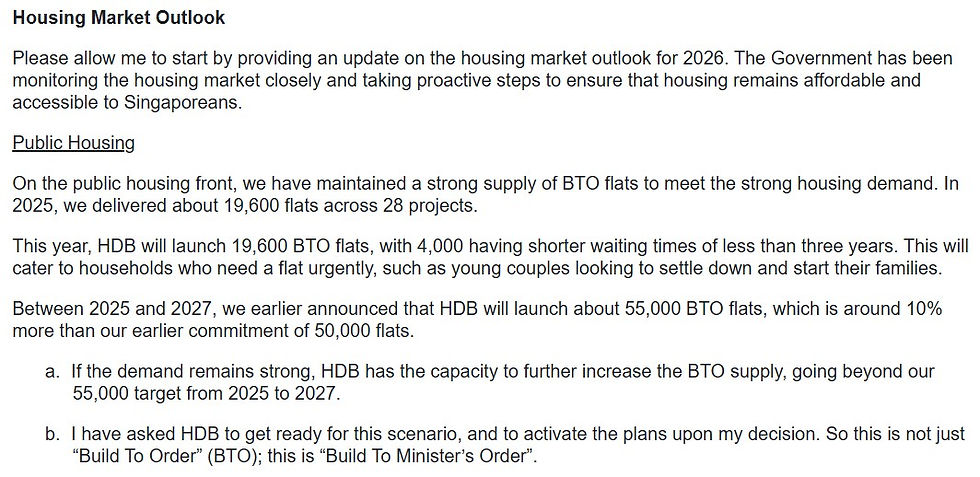
The Government has said it plans to launch about 55,000 BTO flats from 2025 to 2027, and for 2026 alone, HDB will launch about 19,600 BTO flats across three sales exercises. That is a meaningful amount of new supply entering the market.
This matters because when buyers have more new flats to choose from, the resale market is no longer the only path forward.
That does not mean resale HDB demand disappears. It simply means resale sellers now face a buyer pool that has more alternatives than before.
BTO application rates have cooled
The next question is whether buyers are still fighting as hard for BTO flats as before.
The data suggests demand pressure has eased, especially for family-sized flats.
MND said that for 3-room and larger BTO flats, the average first-timer application rate was 2.2 in 2024, down from 4.0 in 2019. It also said that in 2025, the median application rates for first-timer families applying for 3-room and larger BTO flats were between 1.1 and 1.9 times. In the most recent BTO exercise, the median application rate for first-timer families was 0.9 times.
In plain English, buyers are no longer as desperate as they were during the tighter post-COVID period.

And when BTO becomes more accessible again, some buyers who might have entered the resale market out of urgency may now choose to wait for a new flat instead.
That is one reason HDB upgraders cannot assume resale demand will stay as strong as before.
Some BTO projects are even being completed faster
Another key change is waiting time.

HDB has been rolling out more Shorter Waiting Time flats, and some are being completed in less than three years. Projects like West BrickVille @ Bukit Batok were marketed with a waiting time of around two years, while projects like Yishun Glade and Chencharu Grove were offered with waiting times of less than three years. HDB’s annual report also noted a sharp increase in shorter waiting time flats launched in 2025.

Why does this matter?
Because one of the biggest advantages of resale HDB used to be speed, buyers who did not want to wait four or five years often had little choice but to buy resale.
But if some BTO projects can now be completed much faster, that resale advantage becomes less powerful.
Again, more alternatives for buyers means more competition for resale sellers.
A large MOP wave is coming.
The next major supply story is the number of flats reaching their Minimum Occupation Period.
MND said the number of BTO flats reaching MOP will increase from 13,500 in 2026, to 15,000 in 2027, and then 19,500 in 2028.

That is important for one simple reason: more MOP means more homes becoming eligible for resale, and more households starting to think about their next move.
Some will right-size. Some will stay put. Some will upgrade.
But at a market level, this means HDB sellers should expect more competition, not less.
So if you are hoping to wait six more months just to push for a slightly higher number, you need to remember that the resale market may not become easier for you over that period.
New HDB flats are in better locations too
This is another big change that many HDB owners underestimate.
Under HDB’s Standard, Plus and Prime framework, HDB explicitly states that Plus flats are in choicer locations, while Prime flats are in the most central and most desirable locations. HDB also says these flats are given additional subsidies on top of the usual market discounts, so they remain affordable.

That is a major shift.
In the past, many resale flats had a stronger edge because of location. Buyers who wanted mature estates, good connectivity or a central address often had to look harder at resale.
Today, buyers can consider newer HDB flats in better locations, still enjoy subsidies, and in some cases even benefit from shorter waiting times.
That makes the resale HDB market more competitive than many sellers realise.
More HDB choices in 2026 can cap resale upside
When you put all these factors together, the picture becomes clearer.
There is more BTO supply. BTO subscription pressure has eased. Some BTOs are being completed faster. More flats are reaching MOP. And many of the newer flats are in attractive locations under the Plus and Prime framework.
The result is simple: buyers now have more choices.
And when buyers have more choices, it becomes harder for resale sellers to keep pushing prices aggressively unless their flat is genuinely well-positioned.
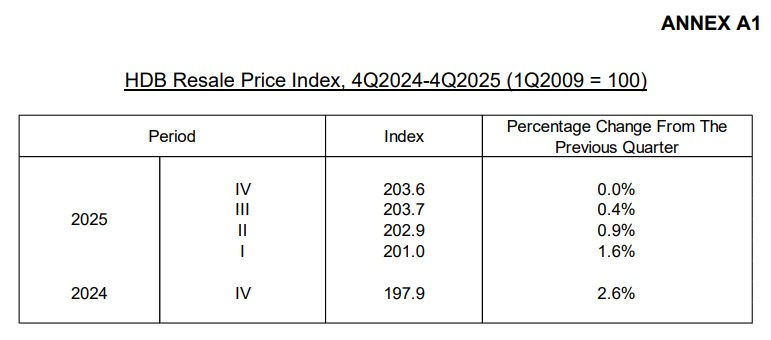
You can already see signs of that in the data. HDB’s Resale Price Index was 203.7 in 3Q2025 and 203.6 in 4Q2025, which means prices were essentially flat quarter on quarter. HDB itself said this was the first time resale prices had remained flat since 1Q2020, after four consecutive quarters of slower price growth.

This does not mean HDB prices are collapsing. That is not what the data says.
But it does suggest that the easy upside may no longer be as easy.
For HDB upgraders, that is a very important distinction.
Now compare that with the non-landed private market
This is where the real challenge begins for many upgraders.
On the private side, supply is not exploding either.
URA said the 1H2026 GLS programme can yield about 9,185 private residential units in total, with 4,575 units on the Confirmed List, and it described this level as being similar to 2H2025. That tells us the government is sustaining land supply, but not flooding the market with an outsized jump in supply.

At the same time, expected private residential completions remain controlled. URA’s pipeline data shows about 6,083 units expected to be completed in 2026 and 8,757 units in 2027.

Then look at en bloc activity. It remained subdued in 2025. The Business Times, citing Knight Frank data, reported that there were only five successful collective sales in 2025, despite at least 16 attempts.

So while private supply is still coming, it is not coming in such a big wave that it dramatically softens the market overnight.
Private property demand comes from a much wider pool
This is the part many HDB owners underestimate.
Private property demand can come from a much broader base: Singapore citizens, Singapore PRs, second-property owners, foreigners and companies, even though different buyer groups face different tax treatment and constraints.
The HDB market is much more regulated and eligibility-driven. Private housing, by nature, has a wider potential buyer pool.
That broader demand base matters because when supply is limited, and demand comes from more directions, private residential prices can stay firmer than many HDB upgraders expect.
And you can see that contrast in the price indices.
While HDB’s resale price index was basically flat at the end of 2025, URA’s Non-Landed Property Price Index rose from 203.4 in 4Q2024 to 208.1 in 4Q2025.
That is the gap many upgraders need to understand.

On the HDB side, buyers have more options. On the private side, supply remains relatively contained, and demand is broader.
That is exactly why some HDB owners feel like they are running on the spot. Their flat does not move up as quickly as they hoped, but the condo they want keeps getting more expensive.
So what should an HDB upgrader do?
This is where expectation management becomes everything.
If you are planning to upgrade your HDB flat, your job is not just to chase the highest possible price and hope the market bends in your favour.
Your job is to understand where your flat sits in today’s market, how much competition you are facing, what buyers are comparing against, and how quickly the private side may move while you wait.
Sometimes the biggest mistake is not selling too low.
It is waiting too long for a price that the market is no longer willing to support.
Think about it this way.
Do you really want to hold out for an extra $10,000 on your HDB flat, only to find that the private property you want is now $40,000 more expensive because you spent six months waiting?
That is how some HDB owners get priced out.
Selling realistically is not the same as selling cheaply
Let me be very clear.
Managing expectations does not mean accepting a poor outcome.
It does not mean undercutting yourself.
It does not mean rushing to sell at any price.And it definitely does not mean we are asking you to sell cheaply.
What it means is selling at a realistic price based on data, competition and market timing.
That is a very different thing.
A realistic price gives you a stronger chance of selling within a good timeframe, reducing the risk that your target private property moves further away from you while you wait.
How we help HDB upgraders avoid getting stuck
This is exactly why our role matters.
We help HDB upgraders look at the market clearly, not emotionally.
We study the competing listings. We analyse buyer alternatives. We look at what BTO, MOP and nearby resale supply are doing. And we position your flat based on real market conditions, not wishful thinking.
Then we use our integrated marketing strategy to give your home the best chance of selling well and selling efficiently, so you can move on to the next stage of your property journey with confidence.
Because at the end of the day, our goal is simple.
We want you to do well.
Not just because we care about the result, but because real estate is a relationship business. If you do well, your friends and family will notice. And when they do, they will know who to call.
We are not here to build transactions. We are here to build relationships.


Final thoughts
If you are an HDB upgrader in 2026, this is the key message:
The HDB market is facing more supply, more alternatives and more competition. The private market still has a limited supply relative to broad demand. That means the move from HDB to condo may become harder if you anchor yourself to unrealistic expectations.
So before you ask for a higher price just because it sounds nice in your head, ask a better question:
What price gives me the best chance of upgrading successfully without getting priced out?
That is the question that matters.
And if you want help answering it with real data and real market insight, reach out to us.
We would be happy to help you plan the move properly.


Comments